<?xml version="1.0" encoding="utf-8"?>
<feed xmlns="http://www.w3.org/2005/Atom">
    <title>silky.github.io</title>
    <subtitle><![CDATA[Website of Noon van der Silk]]></subtitle>
    <link href="https://silky.github.io/atom.xml" rel="self" />
    <link href="https://silky.github.io" />
    <id>https://silky.github.io/atom.xml</id>
    <author>
        <name>Noon van der Silk</name>
        
        <email>noonsilk+-noonsilk@gmail.com</email>
        
    </author>
    <updated>2026-07-24T00:00:00Z</updated>
    <entry>
    <title>Make Reviews Possible Again With This One Simple Trick: Stacked Branches</title>
    <link href="https://silky.github.io/posts/reviews-one-simple-trick.html" />
    <id>https://silky.github.io/posts/reviews-one-simple-trick.html</id>
    <published>2026-07-24T00:00:00Z</published>
    <updated>2026-07-24T00:00:00Z</updated>
    <summary type="html"><![CDATA[<div class="info">
    Posted on July 24, 2026
    
        by Noon van der Silk
    
</div>

<center>
<figure>
<img src="/images/branches-2.webp" alt="A stack of branches." />
<figcaption aria-hidden="true">A stack of branches.</figcaption>
</figure>
</center>
<p>You might’ve already guessed what it is: stacked branches. But if you didn’t
already know that, don’t worry, we’ll go over it shortly.</p>
<p>But first, let’s discuss the problem.</p>
<h3 id="ai-generated-code-is-hard-to-review">AI-generated code is hard to review</h3>
<p>Pretty much everyone using AI has this problem at the moment; it’s moderately
easy to generate code that is mostly coherent, mostly tackles the problem
you’re solving, and in fact it’s so easy, we mostly get a little over-excited
and do too much at once: this makes code hard to review.</p>
<p>This is creating stress on the reviewers, on several fronts. There’s just the
plain apathy of staring a giant diff that <em>probably</em> does what the author
says, <em>even</em> passes your test suites, but also <em>probably</em> contains some
quirky/not-your-codebase’s-idiom things that you’d challenge if you were
motivated.</p>
<p>There’s also the loss of knowledge; it’s just straight-up extremely difficult
to read such large pieces of work and understand everything. Especially when
you can’t totally trust that every line and comment comes from some deep
fundamental understanding of the (human) author.</p>
<p>There’s many other problems; not all of which will be addressed by this idea;
but the key idea here that we will go for is: less is better. It’s easier to
review something when the amount of changes are small; and when you can focus
on just thinking about “one thing”, while performing any specific review.</p>
<h3 id="standard-techniques">Standard techniques</h3>
<p>There are many and ever-growing techniques to deal with this problem:</p>
<ol type="1">
<li><p><em>Just add more tests</em>: Theory is, if it works then It Works. This can be
risky or great, depending on your testing infrastructure. But we all know
that tests don’t cover everything that it’s possible to express with code.</p></li>
<li><p><em>Just do less</em>: Just have smaller PRs. This is hard, because it seems modern
AI systems tend to be a little bit purposefully addictive/gamified: they’re
often finding new things to do while doing a piece of work. It’s also at
odds with most work pressures: deliver more better faster.</p></li>
<li><p><em>Group-reviews</em>: Get everyone on a call (or in person?!), and talk through
the code. This can be useful, but you can’t do it for everything. Also, it
doesn’t work for some team members and thinking styles.</p></li>
<li><p><em>Author and merger responsibility</em>: You can just make a declaration, that,
say, if a (big) PR is found to introduce a bag big or some misunderstanding,
you just fire the author the and merger. Or maybe something less drastic,
like downvote them on their performance reviews. In any case, this one is
punitive and pressure-based. It makes authors and reviewers <em>more</em> nervous;
and doesn’t really empower them in any meaningful way. Ultimately, it will
just slow you down, and upset people.</p></li>
<li><p><em>Stop caring, the market will decide for you</em>: Does you product get better?
Do things work? Are you getting more features? Then who is really to say
what is “correct”? Isn’t the ultimate arbitrar of truth the users anyway?
Shouldn’t we just get more things in front of them as fast as possible?</p>
<p>Obviously, this framing is both correct and crazy. In theory it’s true that
only visible functionality matters; but it’s also true that something can
be visibly accurate but wildly off in ever-so-slightly different
circumstances. We’re not yet at the point where it’s possible to operate
this way. Maybe we’re approaching this with better-tested ecosystems and
the combination of theorem provers in connection with code; but ultimately
we’ll always need to review our stated intention, even in that promised
land.</p>
<p>So let’s just agree that, for the short term, we’re going to need
<em>some</em> kind of human review.</p></li>
<li><p><em>Actually no, just let AI review it</em>: Naturally, we can just have the AI
perform it’s own review. Pragmatically, this can be very effective,
certainly for catching missed things, bugs, security issues, etc. But I
feel for gaining certainity that what you asked for is actually done
correctly, we’re still going to want some oversight.</p></li>
</ol>
<p>Let’s then see an old idea that can still be compatible with any of these
approaches, if we so wished it.</p>
<h3 id="an-old-idea-create-stacked-branches">An old idea: create stacked branches</h3>
<p>I’m not inventing stacked branches here. Many many people love them, there’s
<a href="https://docs.jj-vcs.dev/latest/">jj</a>, created in part to get more joy from
them, and <a href="https://www.ersc.io/">startups</a> focused around the idea.</p>
<p>A stacked branch is conceptually simple:</p>
<ul>
<li>Think about the large bit of work you did,</li>
<li>Break it into (coherent) chunks (each one perhaps passing CI alone),</li>
<li>Create a branch per chunk,</li>
<li>Have each branch depend on the prior one: 1 ← 2 ← 3 ← …</li>
<li>Submit them as PRs in that order</li>
</ul>
<p>Now, you have each coherent change readable by itself; they can be merged in
order, and everything will be fine.</p>
<p>You can read more <a href="https://gist.github.com/thoughtpolice/9c45287550a56b2047c6311fbadebed2">here</a>.</p>
<h3 id="the-new-workflow">The new workflow</h3>
<p>Manually maintaining stacked branches is a little annoying. Yes you can use <code>jj</code>;
but then you have to learn to use <code>jj</code>, convince everyone in your team to
learn it, and <em>still</em> do manual busywork.</p>
<p>Alternatively, you can try and predict all the changes you’re likely to make,
make individual branches and just keep switching around. This is of course
extremely inconvenient and annoying.</p>
<p>But, happily, <em>creating</em> stacked branches from a single monolithic branch is
fairly mechanical, boring, easy to describe, …
What a great use-case for your AI tooling then!</p>
<p>So the new workflow is simply this:</p>
<ol type="1">
<li><p>Create a branch (<code>some-performance-work</code>),</p></li>
<li><p>Hack liberally,</p></li>
<li><p>Ask your AI something like:</p>
<blockquote>
<p>Can you reframe this work into a sequence of stacked PRs. Try and
categorise all the changes into 4-5 chunks, and then make branches based
on that. Please number the branches like <code>some-performance-work-1</code>.</p>
</blockquote></li>
<li><p>Push all the branches and create the PRs.</p></li>
<li><p>Bask in the joy of simple reviewing</p></li>
</ol>
<p>I’ve been experimenting with this a little, and it works quite well! Note that
in my particular workflow, I wait until I’ve done the entire piece of work,
and split it after the fact. Splitting it before requires a bit more <code>jj</code>
busywork than I care to get into at the moment.</p>
<h3 id="open-questions-and-downsides">Open questions and downsides</h3>
<p>Here’s a dot-point list of open questions, downsides, and trivia to think
about.</p>
<ul>
<li><p>GitHub’s UI is annoying for stacked PRs: They should thread them, like Gmail
did back in the day. It would be so much nicer. There’s a world of
improvements alternative source-control companies could make here that would
make this all so much more pleasant.</p></li>
<li><p>CI could be super annoying/wasteful/slow: Depending on what you do, you
might accidentaly waste hours on rebuilds with this style. One should spend
some time thinking about it. (Advertisement: Actually, I think this is an
interesting open area of research, and if you’re struggling with it or
want to talk more, reach out to me via <a href="https://invariant.club/">Invariant.Club</a>!)</p></li>
<li><p>Atomic stacking: Perhaps you shouldn’t have the first one merge direct to
<code>main</code>, you should instead target it to some <code>xxx-stacked</code> <em>new</em> branch,
that’s based on <code>main</code>, but allows you to do some final re-orgs as you go.
Otherwise, you tend to need to merge <em>every step</em> of a stacked branch set
basically at the same time, because you want coherence and mostly these
things are coherent only once <em>everything</em> is complete; i.e. if you merge
steps 1-4 of a 5-step stack, do you actually <em>need</em> all those steps if you
reject step 5? Targetting a new branch gives you some flexibility here. It
also gives you a final clear PR history that shows before-and-after
benefits; something you might not get depending on how you merge otherwise.</p>
<p>Further, you might also want to protect your merged stack queue from being
interrupted by some other unrelated merge to the <code>main</code> branch, that happens
while you’re merging your stack.</p></li>
<li><p>It’s easier post-fact: I personally find it hard to do this from the start.
In fact one could argue, if I could do it from the start, I’d have separate
PRs already!</p></li>
<li><p>Maybe learn <code>jj</code>, or maybe don’t worry. It’s probably very useful to master
<code>jj</code> if you want to get into this more. But don’t let <em>not</em> mastering it
stop you from benefiting now.</p></li>
<li><p>Probably some work could be done to make AI tooling a little more capable to
manage a set of arguably-independent branches more coherently. I.e. normally
it’s pretty easy to isolate independent hacking with git worktrees; but
they’re 1-1 with branches; now that we’re potentially 1:many, it requires a
little more care and attention.</p></li>
</ul>
<h3 id="conclusion">Conclusion</h3>
<p>In general, there’s a wide world to explore in this domain of AI-assisted work
partitioning for efficient review and compilation. Looking forward to seeing
more work in this area!</p>
<h4 id="updates">Updates</h4>
<ul>
<li>August 2026 - <a href="https://github.blog/changelog/2026-07-30-stacked-pull-requests-are-now-in-public-preview/">GitHub recently announced UI support for stacked PRs</a></li>
</ul>
]]></summary>
</entry>
<entry>
    <title>Installing NixOS with the latest kernel</title>
    <link href="https://silky.github.io/posts/nixos-latest-kernel.html" />
    <id>https://silky.github.io/posts/nixos-latest-kernel.html</id>
    <published>2025-01-07T00:00:00Z</published>
    <updated>2025-01-07T00:00:00Z</updated>
    <summary type="html"><![CDATA[<div class="info">
    Posted on January  7, 2025
    
        by Noon van der Silk
    
</div>

<p>You may find yourself in the following situation:</p>
<ul>
<li>You have a new computer,</li>
<li>It requires the some latest kernel features to work (perhaps for WiFi or
something else),</li>
<li>You want to install NixOS,</li>
<li>And the latest ISO you download doesn’t work.</li>
</ul>
<p>One potential reason for the failure could be that your new computer requires
the latest linux <code>kernelPackages</code> in order to work; i.e. something like:</p>
<pre><code>boot.kernelPackages = pkgs.linuxPackages_latest;</code></pre>
<p>In your <code>configuration.nix</code>.</p>
<p>But, not to worry! You can follow the
<a href="https://nixos.org/manual/nixos/stable/#sec-booting-from-usb">documentation</a>
to build your <em>own</em> ISO image; something like so (with flakes):</p>
<div class="sourceCode" id="cb2"><pre class="sourceCode nix"><code class="sourceCode nix"><span id="cb2-1"><a href="#cb2-1" aria-hidden="true" tabindex="-1"></a><span class="co"># flake.nix</span></span>
<span id="cb2-2"><a href="#cb2-2" aria-hidden="true" tabindex="-1"></a><span class="op">{</span></span>
<span id="cb2-3"><a href="#cb2-3" aria-hidden="true" tabindex="-1"></a>  <span class="va">description</span> <span class="op">=</span> <span class="st">&quot;Custom NixOS installation&quot;</span><span class="op">;</span></span>
<span id="cb2-4"><a href="#cb2-4" aria-hidden="true" tabindex="-1"></a>  <span class="va">inputs</span>.<span class="va">nixpkgs</span>.<span class="va">url</span> <span class="op">=</span> <span class="st">&quot;github:NixOS/nixpkgs/nixos-unstable&quot;</span><span class="op">;</span></span>
<span id="cb2-5"><a href="#cb2-5" aria-hidden="true" tabindex="-1"></a>  <span class="va">outputs</span> <span class="op">=</span> <span class="op">{</span> <span class="va">self</span><span class="op">,</span> <span class="va">nixpkgs</span> <span class="op">}</span>:</span>
<span id="cb2-6"><a href="#cb2-6" aria-hidden="true" tabindex="-1"></a>  <span class="op">{</span></span>
<span id="cb2-7"><a href="#cb2-7" aria-hidden="true" tabindex="-1"></a>    <span class="va">nixosConfigurations</span> <span class="op">=</span> <span class="op">{</span></span>
<span id="cb2-8"><a href="#cb2-8" aria-hidden="true" tabindex="-1"></a>      <span class="va">iso</span> <span class="op">=</span> nixpkgs<span class="op">.</span>lib<span class="op">.</span>nixosSystem <span class="op">{</span></span>
<span id="cb2-9"><a href="#cb2-9" aria-hidden="true" tabindex="-1"></a>        <span class="va">system</span> <span class="op">=</span> <span class="st">&quot;x86_64-linux&quot;</span><span class="op">;</span></span>
<span id="cb2-10"><a href="#cb2-10" aria-hidden="true" tabindex="-1"></a>        <span class="va">modules</span> <span class="op">=</span> <span class="op">[</span></span>
<span id="cb2-11"><a href="#cb2-11" aria-hidden="true" tabindex="-1"></a>          <span class="op">{</span> <span class="va">nixpkgs</span>.<span class="va">overlays</span> <span class="op">=</span> overlays<span class="op">;</span> <span class="op">}</span></span>
<span id="cb2-12"><a href="#cb2-12" aria-hidden="true" tabindex="-1"></a>          <span class="op">({</span> <span class="va">pkgs</span><span class="op">,</span> <span class="va">modulesPath</span><span class="op">,</span> <span class="op">...</span> <span class="op">}</span>:</span>
<span id="cb2-13"><a href="#cb2-13" aria-hidden="true" tabindex="-1"></a>          <span class="op">{</span></span>
<span id="cb2-14"><a href="#cb2-14" aria-hidden="true" tabindex="-1"></a>            <span class="va">imports</span> <span class="op">=</span></span>
<span id="cb2-15"><a href="#cb2-15" aria-hidden="true" tabindex="-1"></a>              <span class="kw">let</span> <span class="va">cd-drv</span> <span class="op">=</span> <span class="st">&quot;installation-cd-graphical-calamares-gnome&quot;</span><span class="op">;</span></span>
<span id="cb2-16"><a href="#cb2-16" aria-hidden="true" tabindex="-1"></a>              <span class="kw">in</span> <span class="op">[</span> <span class="st">&quot;</span><span class="sc">${</span>modulesPath<span class="sc">}</span><span class="st">/installer/cd-dvd/</span><span class="sc">${</span>cd<span class="op">-</span>drv<span class="sc">}</span><span class="st">.nix&quot;</span> <span class="op">];</span></span>
<span id="cb2-17"><a href="#cb2-17" aria-hidden="true" tabindex="-1"></a></span>
<span id="cb2-18"><a href="#cb2-18" aria-hidden="true" tabindex="-1"></a>            <span class="co"># Use the latest kernel packages!</span></span>
<span id="cb2-19"><a href="#cb2-19" aria-hidden="true" tabindex="-1"></a>            <span class="va">boot</span>.<span class="va">kernelPackages</span> <span class="op">=</span> pkgs<span class="op">.</span>linuxPackages_latest<span class="op">;</span></span>
<span id="cb2-20"><a href="#cb2-20" aria-hidden="true" tabindex="-1"></a>          <span class="op">})</span></span>
<span id="cb2-21"><a href="#cb2-21" aria-hidden="true" tabindex="-1"></a>        <span class="op">];</span></span>
<span id="cb2-22"><a href="#cb2-22" aria-hidden="true" tabindex="-1"></a>      <span class="op">};</span></span>
<span id="cb2-23"><a href="#cb2-23" aria-hidden="true" tabindex="-1"></a>    <span class="op">};</span></span>
<span id="cb2-24"><a href="#cb2-24" aria-hidden="true" tabindex="-1"></a>  <span class="op">};</span></span>
<span id="cb2-25"><a href="#cb2-25" aria-hidden="true" tabindex="-1"></a><span class="op">}</span></span></code></pre></div>
<p>Run like:</p>
<pre class="shell"><code>nix build .#nixosConfigurations.iso.config.system.build.isoImage</code></pre>
<p>Which will produce an iso file that you can mount something like:</p>
<pre class="shell"><code>sudo dd \
  bs=4M \
  conv=fsync \
  oflag=direct \
  status=progress \
  if=./result/iso/the-image-name.iso \
  of=/dev/sda</code></pre>
<p>The most important fact here is that you select the <em>calamares</em> variant of the
<a href="https://github.com/NixOS/nixpkgs/tree/master/nixos/modules/installer/cd-dvd">installation
iso’s</a>.
<a href="https://github.com/calamares/calamares/">Calamares</a> is the graphical
installer. (Note: If you wanted the <em>minimal</em> installer, you can actually
download that from the nixos hydra instance directly:
<a href="https://hydra.nixos.org/job/nixos/trunk-combined/nixos.iso_minimal_new_kernel_no_zfs.x86_64-linux"><code>nixos.iso_minimal_new_kernel</code></a>,
but actually this will only get you one step further; which I will elaborate
on momentarily.)</p>
<p>The trouble is that while this will be enough to get the <em>installer</em> to run,
you will not be able to run the resulting installed NixOS! This is because
Calamares writes the final <code>configuration.nix</code> of the new system, and it does
not consider (wisely or otherwise) the system state of the <em>installer</em> image
when it does so. <a href="#fn1" class="footnote-ref" id="fnref1" role="doc-noteref"><sup>1</sup></a></p>
<p>So, the answer, naturally, is fork Calamares and change it the way we want! In
fact, glancing at the <a href="https://github.com/NixOS/nixpkgs/blob/master/nixos/modules/installer/cd-dvd/installation-cd-graphical-calamares.nix#L19">relevant
derivation</a> we learn that it’s <a href="https://github.com/NixOS/calamares-nixos-extensions">calamares-nixos-extensions</a> that we need to fork.</p>
<p>If we just want to hack our way through, we just make some small changes <a href="https://github.com/NixOS/calamares-nixos-extensions/compare/calamares...silky:calamares-nixos-extensions:latest-kernel">to
that code</a>,
and then adjust our flake file as follows:</p>
<pre class="lang=nix"><code># flake.nix
{
  description = &quot;Custom NixOS installation&quot;;
  inputs.nixpkgs.url = &quot;github:NixOS/nixpkgs/nixos-unstable&quot;;
  outputs = { self, nixpkgs }:

  # Define an overlay to update the `calamares-nixos-extensions` used.
  let overlays = [
        (_: final: {
          calamares-nixos-extensions =
            # Update to use our fork
            final.calamares-nixos-extensions.overrideAttrs (_: _: {
              src = final.fetchFromGitHub {
                owner = &quot;silky&quot;;
                repo = &quot;calamares-nixos-extensions&quot;;
                rev = &quot;latest-kernel&quot;;
                hash = &quot;sha256-PEWH+YpmP4qD7IZJLcD9rYl+GEuHqbS/OQsaNUZYBMg=&quot;;
              };
            });
        })
      ];
  in
  {
    nixosConfigurations = {
      iso = nixpkgs.lib.nixosSystem {
        system = &quot;x86_64-linux&quot;;
        modules = [
          { nixpkgs.overlays = overlays; }
          ({ pkgs, modulesPath, ... }:
          {
            imports =
              let cd-drv = &quot;installation-cd-graphical-calamares-gnome&quot;;
              in [ &quot;${modulesPath}/installer/cd-dvd/${cd-drv}.nix&quot; ];

            # Use the latest kernel packages!
            boot.kernelPackages = pkgs.linuxPackages_latest;
          })
        ];
      };
    };
  };
}</code></pre>
<p>And success! This results in an installer that will first of all even run, and
second of all install a NixOS that will <em>also</em> run!</p>
<p><strong>Update</strong>: Note that, in fact, as I was writing this blog-post, I noticed that
the main repo already includes a <a href="https://github.com/NixOS/calamares-nixos-extensions/commit/381e34385106f548568ece2395806a6ab4cf6e5f">better version of this
fix</a>,
from a few days ago!<a href="#fn2" class="footnote-ref" id="fnref2" role="doc-noteref"><sup>2</sup></a> This is just more validation of one of my nix mantras:
something isn’t working? Just wait a few days, probably it will be fixed!</p>
<p><strong>Trivia</strong>: I had dreams of making this an option you could opt-into in the
installer by editing the calamares script; but in fact this is more
complicated than one might wish; you can get a sense for how annoying this is
by looking at <a href="https://github.com/NixOS/nixpkgs/blob/master/pkgs/tools/misc/calamares/0004-Adds-unfree-qml-to-packagechooserq.patch">the patch
required</a>
to allow someone to select “unfree” during the installation process.</p>
<section id="footnotes" class="footnotes footnotes-end-of-document" role="doc-endnotes">
<hr />
<ol>
<li id="fn1"><p>Thanks to <a href="https://github.com/ElvishJerricco">ElvishJerricco</a> for this hint.<a href="#fnref1" class="footnote-back" role="doc-backlink">↩︎</a></p></li>
<li id="fn2"><p>Thanks again to ElvishJerricco!<a href="#fnref2" class="footnote-back" role="doc-backlink">↩︎</a></p></li>
</ol>
</section>
]]></summary>
</entry>
<entry>
    <title>HTMX and Servant: Seamless and powerful handling of HTTP errors in HTMX</title>
    <link href="https://silky.github.io/posts/htmx-haskell-interview.html" />
    <id>https://silky.github.io/posts/htmx-haskell-interview.html</id>
    <published>2024-05-06T00:00:00Z</published>
    <updated>2024-05-06T00:00:00Z</updated>
    <summary type="html"><![CDATA[<div class="info">
    Posted on May  6, 2024
    
        by Noon van der Silk
    
</div>

<p>As part of the interview process for a company I was recently rejected by, I
wrote a blog post about HTMX and Haskell (and, JavaScript, but that was just a
requirement :D).</p>
<p>I think the post is interesting in any case, so here it is :) The Haskell
component is in the <code>Bonus content</code>. If you want to skip straight to the code,
you can just go direct to the repo:
<a href="https://github.com/silky/htmx-servant-js-post">htmx-servant-js-example</a>.</p>
<h1 id="seamless-and-powerful-handling-of-http-errors-in-htmx">Seamless and powerful handling of HTTP errors in HTMX</h1>
<p><a href="https://htmx.org/">HTMX</a> is a popular front-end JavaScript library that can
be used to create simple dynamic UIs. But how robust is it? Is it ready for
production use? And what are its features, anyway? Let’s explore it
together by building an image conversion app.</p>
<h2 id="problem">Problem</h2>
<p>You are building a dynamic UI and calling endpoints that will either fail or
return some content to render. You want to handle both these cases with the
simplest code possible.</p>
<p>A typical workflow somewhere in your code is to query the endpoint, check the
status of what happened, and act accordingly:</p>
<div class="sourceCode" id="cb1"><pre class="sourceCode javascript"><code class="sourceCode javascript"><span id="cb1-1"><a href="#cb1-1" aria-hidden="true" tabindex="-1"></a><span class="fu">fetch</span>(url)</span>
<span id="cb1-2"><a href="#cb1-2" aria-hidden="true" tabindex="-1"></a>  <span class="op">.</span><span class="fu">then</span>( (result) <span class="kw">=&gt;</span> {</span>
<span id="cb1-3"><a href="#cb1-3" aria-hidden="true" tabindex="-1"></a>    <span class="cf">if</span> (result<span class="op">.</span><span class="at">ok</span>) {</span>
<span id="cb1-4"><a href="#cb1-4" aria-hidden="true" tabindex="-1"></a>      <span class="co">// Everything is good!</span></span>
<span id="cb1-5"><a href="#cb1-5" aria-hidden="true" tabindex="-1"></a>    } <span class="cf">else</span> {</span>
<span id="cb1-6"><a href="#cb1-6" aria-hidden="true" tabindex="-1"></a>      <span class="co">// Something else ...</span></span>
<span id="cb1-7"><a href="#cb1-7" aria-hidden="true" tabindex="-1"></a>    }</span>
<span id="cb1-8"><a href="#cb1-8" aria-hidden="true" tabindex="-1"></a>})</span></code></pre></div>
<p>It’s a bit of a hassle to write this logic all over the place. Can HTMX help
us out here? How does it look for something non-trivial, and what are the
caveats we should be aware of?</p>
<h2 id="solution">Solution</h2>
<p>Let’s take the example of uploading an image and converting it from a PNG to a
JPG.</p>
<p>Naturally, HTMX can do the happy-path, when there are no errors, easily. We
define the form, with the <a href="https://htmx.org/reference/">HTMX attributes</a> to
define how the DOM changes based on the result:</p>
<div class="sourceCode" id="cb2"><pre class="sourceCode html"><code class="sourceCode html"><span id="cb2-1"><a href="#cb2-1" aria-hidden="true" tabindex="-1"></a><span class="co">&lt;!-- index.html --&gt;</span></span>
<span id="cb2-2"><a href="#cb2-2" aria-hidden="true" tabindex="-1"></a><span class="dt">&lt;</span><span class="kw">script</span><span class="ot"> src</span><span class="op">=</span><span class="st">&quot;https://unpkg.com/htmx.org@1.9.11&quot;</span><span class="dt">&gt;&lt;/</span><span class="kw">script</span><span class="dt">&gt;</span></span>
<span id="cb2-3"><a href="#cb2-3" aria-hidden="true" tabindex="-1"></a>...</span>
<span id="cb2-4"><a href="#cb2-4" aria-hidden="true" tabindex="-1"></a><span class="dt">&lt;</span><span class="kw">body</span><span class="dt">&gt;</span></span>
<span id="cb2-5"><a href="#cb2-5" aria-hidden="true" tabindex="-1"></a>  <span class="dt">&lt;</span><span class="kw">form</span></span>
<span id="cb2-6"><a href="#cb2-6" aria-hidden="true" tabindex="-1"></a><span class="ot">    hx-encoding</span><span class="op">=</span><span class="st">&quot;multipart/form-data&quot;</span></span>
<span id="cb2-7"><a href="#cb2-7" aria-hidden="true" tabindex="-1"></a><span class="ot">    hx-post</span><span class="op">=</span><span class="st">&quot;/upload&quot;</span></span>
<span id="cb2-8"><a href="#cb2-8" aria-hidden="true" tabindex="-1"></a><span class="ot">    hx-target</span><span class="op">=</span><span class="st">&quot;#result&quot;</span></span>
<span id="cb2-9"><a href="#cb2-9" aria-hidden="true" tabindex="-1"></a><span class="ot">    hx-swap</span><span class="op">=</span><span class="st">&quot;innerHTML&quot;</span></span>
<span id="cb2-10"><a href="#cb2-10" aria-hidden="true" tabindex="-1"></a><span class="ot">    </span><span class="dt">&gt;</span></span>
<span id="cb2-11"><a href="#cb2-11" aria-hidden="true" tabindex="-1"></a>    <span class="dt">&lt;</span><span class="kw">input</span><span class="ot"> type</span><span class="op">=</span><span class="st">&quot;file&quot;</span><span class="ot"> name</span><span class="op">=</span><span class="st">&quot;image&quot;</span><span class="ot"> accept</span><span class="op">=</span><span class="st">&quot;image/png&quot;</span><span class="ot"> </span><span class="dt">/&gt;</span></span>
<span id="cb2-12"><a href="#cb2-12" aria-hidden="true" tabindex="-1"></a>    <span class="dt">&lt;</span><span class="kw">button</span><span class="dt">&gt;</span>Upload<span class="dt">&lt;/</span><span class="kw">button</span><span class="dt">&gt;</span></span>
<span id="cb2-13"><a href="#cb2-13" aria-hidden="true" tabindex="-1"></a>  <span class="dt">&lt;/</span><span class="kw">form</span><span class="dt">&gt;</span></span>
<span id="cb2-14"><a href="#cb2-14" aria-hidden="true" tabindex="-1"></a>  <span class="dt">&lt;</span><span class="kw">div</span><span class="ot"> id</span><span class="op">=</span><span class="st">&quot;result&quot;</span><span class="dt">&gt;&lt;/</span><span class="kw">div</span><span class="dt">&gt;</span></span>
<span id="cb2-15"><a href="#cb2-15" aria-hidden="true" tabindex="-1"></a><span class="dt">&lt;/</span><span class="kw">bod</span><span class="dt">&gt;</span></span></code></pre></div>
<p>On the server, at the <code>/upload</code> route, we return an HTML element:</p>
<div class="sourceCode" id="cb3"><pre class="sourceCode javascript"><code class="sourceCode javascript"><span id="cb3-1"><a href="#cb3-1" aria-hidden="true" tabindex="-1"></a><span class="co">// server.js endpoint definition</span></span>
<span id="cb3-2"><a href="#cb3-2" aria-hidden="true" tabindex="-1"></a>app<span class="op">.</span><span class="fu">post</span>(<span class="st">&quot;/upload&quot;</span><span class="op">,</span> <span class="kw">async</span> <span class="kw">function</span>(req<span class="op">,</span> resp) {</span>
<span id="cb3-3"><a href="#cb3-3" aria-hidden="true" tabindex="-1"></a>  <span class="co">// image conversion steps; new image in `newPath`.</span></span>
<span id="cb3-4"><a href="#cb3-4" aria-hidden="true" tabindex="-1"></a>  <span class="co">// ...</span></span>
<span id="cb3-5"><a href="#cb3-5" aria-hidden="true" tabindex="-1"></a>  <span class="co">// send the resulting path back as an &quot;img&quot; tag</span></span>
<span id="cb3-6"><a href="#cb3-6" aria-hidden="true" tabindex="-1"></a>  resp<span class="op">.</span><span class="fu">send</span>(<span class="vs">`&lt;img src=&quot;</span><span class="sc">${</span>newPath<span class="sc">}</span><span class="vs">&quot; /&gt;`</span>)<span class="op">;</span></span>
<span id="cb3-7"><a href="#cb3-7" aria-hidden="true" tabindex="-1"></a>  })<span class="op">;</span></span></code></pre></div>
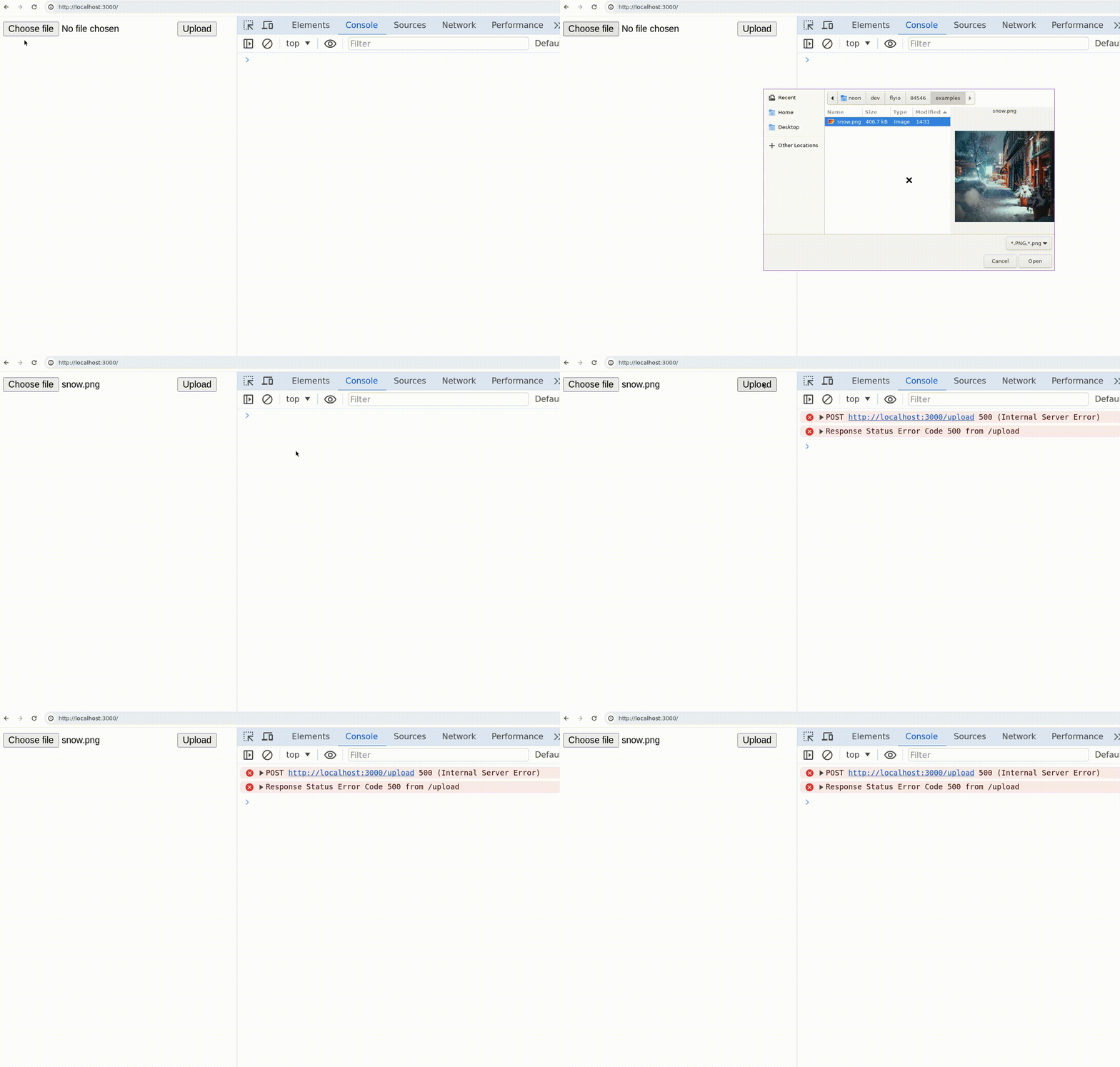
<p>Here’s what it looks like:</p>
<center>
<img width="600" src="/images/happy-path.gif" />
</center>
<p>It’s interesting to note:</p>
<ul>
<li>It looks pretty smooth!</li>
<li>We tell HTMX which element to update (via a CSS selector) with <code>hx-target</code>,</li>
<li>We tell it how with <a href="https://htmx.org/attributes/hx-swap/"><code>hx-swap</code></a> (it’s
important that we use <code>innerHTML</code> so the main target element persists if we
upload a different image),</li>
</ul>
<p>These are some questions I’m asking myself at this point:</p>
<ul>
<li>What would happen if we didn’t return a HTML element from the response?</li>
<li>What would happen if we didn’t return HTTP status 200?</li>
</ul>
<p>We can actually already answer the first question, given what we know about
<code>innerHTML</code>: whatever text is returned from our <code>/upload</code> route is
directly set as the <code>innerHTML</code>, so we best make sure it’s valid HTML :)</p>
<p>For our second question, let’s just try it!</p>
<div class="sourceCode" id="cb4"><pre class="sourceCode javascript"><code class="sourceCode javascript"><span id="cb4-1"><a href="#cb4-1" aria-hidden="true" tabindex="-1"></a><span class="co">// update server.js to just through an error:</span></span>
<span id="cb4-2"><a href="#cb4-2" aria-hidden="true" tabindex="-1"></a>app<span class="op">.</span><span class="fu">post</span>(<span class="st">&quot;/upload&quot;</span><span class="op">,</span> <span class="kw">async</span> <span class="kw">function</span>(req<span class="op">,</span> resp) {</span>
<span id="cb4-3"><a href="#cb4-3" aria-hidden="true" tabindex="-1"></a>  <span class="cf">return</span> resp<span class="op">.</span><span class="fu">status</span>(<span class="dv">500</span>)<span class="op">.</span><span class="fu">send</span>(<span class="vs">`Sorry, no thanks.`</span>)<span class="op">;</span></span>
<span id="cb4-4"><a href="#cb4-4" aria-hidden="true" tabindex="-1"></a>}</span></code></pre></div>
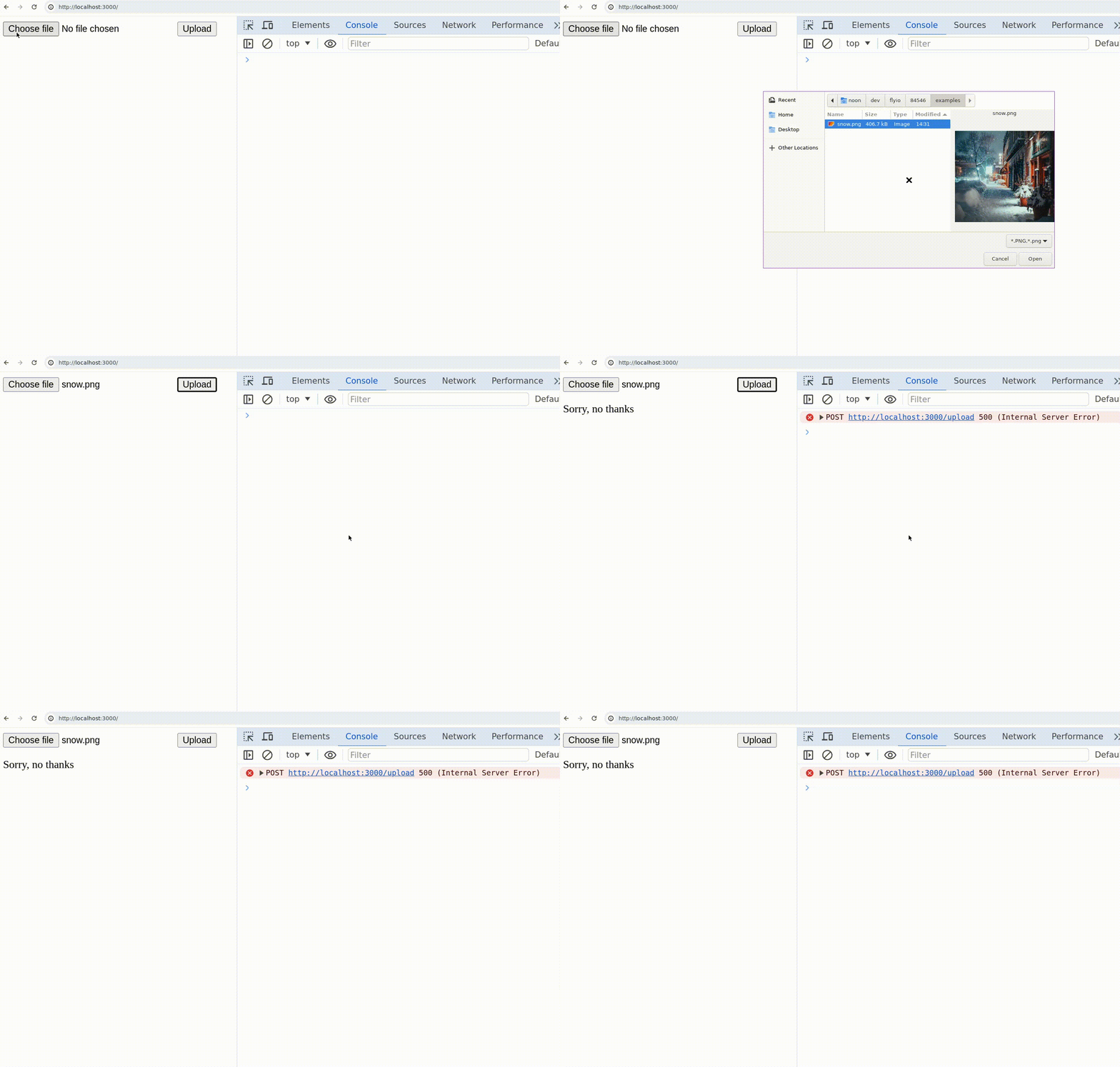
<p>Then:</p>
<center>
<img width="600" src="/images/500-error.gif" />
</center>
<p>We can see that nothing gets rendered, and we see the errors in the console.</p>
<p>With what we’ve seen so far, we would be justified in assuming that the text
<code>Sorry, no thanks</code> might have come through to the <code>&lt;div id="result"&gt;</code> element,
but in fact if the response is a HTTP error code HTMX doesn’t perform
subsequent steps (typically a good idea when something has gone wrong!)</p>
<p>Luckily, there is an extension:
<a href="https://htmx.org/extensions/response-targets/">response-targets</a> that we can
use to get the behaviour we are after. Phew! We can make the following
modifications to our <code>index.html</code> page:</p>
<div class="sourceCode" id="cb5"><pre class="sourceCode html"><code class="sourceCode html"><span id="cb5-1"><a href="#cb5-1" aria-hidden="true" tabindex="-1"></a><span class="co">&lt;!-- index.html --&gt;</span></span>
<span id="cb5-2"><a href="#cb5-2" aria-hidden="true" tabindex="-1"></a><span class="dt">&lt;</span><span class="kw">script</span><span class="ot"> src</span><span class="op">=</span><span class="st">&quot;https://unpkg.com/htmx.org@1.9.11&quot;</span><span class="dt">&gt;&lt;/</span><span class="kw">script</span><span class="dt">&gt;</span></span>
<span id="cb5-3"><a href="#cb5-3" aria-hidden="true" tabindex="-1"></a><span class="dt">&lt;</span><span class="kw">script</span><span class="ot"> src</span><span class="op">=</span><span class="st">&quot;https://unpkg.com/htmx.org@1.9.11/dist/ext/response-targets.js&quot;</span><span class="dt">&gt;&lt;/</span><span class="kw">script</span><span class="dt">&gt;</span></span>
<span id="cb5-4"><a href="#cb5-4" aria-hidden="true" tabindex="-1"></a>...</span>
<span id="cb5-5"><a href="#cb5-5" aria-hidden="true" tabindex="-1"></a></span>
<span id="cb5-6"><a href="#cb5-6" aria-hidden="true" tabindex="-1"></a><span class="dt">&lt;</span><span class="kw">body</span><span class="ot"> hx-ext</span><span class="op">=</span><span class="st">&quot;response-targets&quot;</span><span class="dt">&gt;</span></span>
<span id="cb5-7"><a href="#cb5-7" aria-hidden="true" tabindex="-1"></a>  <span class="dt">&lt;</span><span class="kw">form</span></span>
<span id="cb5-8"><a href="#cb5-8" aria-hidden="true" tabindex="-1"></a><span class="ot">    hx-encoding</span><span class="op">=</span><span class="st">&quot;multipart/form-data&quot;</span></span>
<span id="cb5-9"><a href="#cb5-9" aria-hidden="true" tabindex="-1"></a><span class="ot">    hx-post</span><span class="op">=</span><span class="st">&quot;/upload&quot;</span></span>
<span id="cb5-10"><a href="#cb5-10" aria-hidden="true" tabindex="-1"></a><span class="ot">    hx-target</span><span class="op">=</span><span class="st">&quot;#result&quot;</span></span>
<span id="cb5-11"><a href="#cb5-11" aria-hidden="true" tabindex="-1"></a><span class="ot">    hx-target-error</span><span class="op">=</span><span class="st">&quot;#result&quot;</span></span>
<span id="cb5-12"><a href="#cb5-12" aria-hidden="true" tabindex="-1"></a><span class="ot">    hx-swap</span><span class="op">=</span><span class="st">&quot;innerHTML&quot;</span></span>
<span id="cb5-13"><a href="#cb5-13" aria-hidden="true" tabindex="-1"></a><span class="ot">    </span><span class="dt">&gt;</span></span>
<span id="cb5-14"><a href="#cb5-14" aria-hidden="true" tabindex="-1"></a>    <span class="dt">&lt;</span><span class="kw">input</span><span class="ot"> type</span><span class="op">=</span><span class="st">&quot;file&quot;</span><span class="ot"> name</span><span class="op">=</span><span class="st">&quot;image&quot;</span><span class="ot"> accept</span><span class="op">=</span><span class="st">&quot;image/png&quot;</span><span class="ot"> </span><span class="dt">/&gt;</span></span>
<span id="cb5-15"><a href="#cb5-15" aria-hidden="true" tabindex="-1"></a>    <span class="dt">&lt;</span><span class="kw">button</span><span class="dt">&gt;</span></span>
<span id="cb5-16"><a href="#cb5-16" aria-hidden="true" tabindex="-1"></a>      Upload</span>
<span id="cb5-17"><a href="#cb5-17" aria-hidden="true" tabindex="-1"></a>    <span class="dt">&lt;/</span><span class="kw">button</span><span class="dt">&gt;</span></span>
<span id="cb5-18"><a href="#cb5-18" aria-hidden="true" tabindex="-1"></a>  <span class="dt">&lt;/</span><span class="kw">form</span><span class="dt">&gt;</span></span>
<span id="cb5-19"><a href="#cb5-19" aria-hidden="true" tabindex="-1"></a>  <span class="dt">&lt;</span><span class="kw">div</span><span class="ot"> id</span><span class="op">=</span><span class="st">&quot;result&quot;</span><span class="dt">&gt;&lt;/</span><span class="kw">div</span><span class="dt">&gt;</span></span>
<span id="cb5-20"><a href="#cb5-20" aria-hidden="true" tabindex="-1"></a><span class="dt">&lt;/</span><span class="kw">body</span><span class="dt">&gt;</span></span></code></pre></div>
<p>What did we do?</p>
<ul>
<li>We added a dependency on <code>dist/ext/response-targets.js</code></li>
<li>We added `hx-ext=“response-targets” to the <em>parent</em> of the elements we want to
use it on (<a href="https://htmx.org/attributes/hx-ext/">read more about hx-ext</a>; I
forgot this initially and was wondering why it didn’t work!)</li>
<li>We used the catch-all <code>hx-target-error</code> to send all errors to the
<code>id="result"</code> element, just for simplicity (<a href="https://htmx.org/extensions/response-targets/#wildcard-resolution">you can target specific error
codes if you wish</a>).</li>
</ul>
<p>Here’s how it looks now:</p>
<center>
<img width="600" src="/images/render-error.gif" />
</center>
<p>Success! We see the error rendered in the page! And in the case that we don’t
hit an error, we will still render the image directly as well. That’s exactly
what we wanted! :)</p>
<h2 id="discussion">Discussion</h2>
<p>It’s pretty nice to use HTMX to handle HTTP errors from your API: use
<a href="https://htmx.org/extensions/response-targets/">response-targets</a> to pick up
specific errors, or all of them, and render the contents directly in the page!</p>
<p>A small detail that I came across along the way is the difference between
<code>outerHTML</code> and <code>innerHTML</code> and what you might consider <em>repeated behaviour</em>
while preserving the most “meaningful” structure for your HTMX documents.</p>
<p>The scenario is this: Imagine you want to repeatedly convert images; then you
need to make sure that the HTML element of <code>hx-target</code> persists; with
<code>innerHTML</code> it always will, but with <code>outerHTML</code> it will be replaced. The
advantage of <code>outerHTML</code> is it’s a bit more “meaningful” to replace an <code>&lt;img&gt;</code>
tag with another <code>&lt;img&gt;</code> tag; and likewise. But, ultimately, it’s up to you to
pick the style you prefer.</p>
<h2 id="bonus-content-the-server-is-now-in-haskell">Bonus content: The server is now in Haskell</h2>
<p>HTMX is, after all, a front-end technology, so we can continue to use it if we
have our server in a different language.</p>
<p>It turns out Haskell will let us express one interesting requirement
of using HTMX: our routes should return <em>HTML</em>, not, say, JSON, or plain text.</p>
<p>In the <a href="https://www.servant.dev/">Servant</a> ecosystem, you would having
something like the following<a href="#fn1" class="footnote-ref" id="fnref1" role="doc-noteref"><sup>1</sup></a> to define the <code>/upload</code> endpoint:</p>
<div class="sourceCode" id="cb6"><pre class="sourceCode haskell"><code class="sourceCode haskell"><span id="cb6-1"><a href="#cb6-1" aria-hidden="true" tabindex="-1"></a><span class="co">-- Main.hs</span></span>
<span id="cb6-2"><a href="#cb6-2" aria-hidden="true" tabindex="-1"></a><span class="kw">data</span> <span class="dt">Routes</span> mode <span class="ot">=</span> <span class="dt">Routes</span></span>
<span id="cb6-3"><a href="#cb6-3" aria-hidden="true" tabindex="-1"></a>  {<span class="ot"> upload ::</span> mode <span class="op">:-</span> <span class="st">&quot;upload&quot;</span> <span class="op">:&gt;</span> <span class="dt">MultipartForm</span> <span class="dt">Mem</span> (<span class="dt">MultipartData</span> <span class="dt">Mem</span>) <span class="op">:&gt;</span> <span class="dt">Post</span> &#39;[<span class="dt">HTML</span>] <span class="dt">Html</span></span>
<span id="cb6-4"><a href="#cb6-4" aria-hidden="true" tabindex="-1"></a>  , <span class="op">...</span></span>
<span id="cb6-5"><a href="#cb6-5" aria-hidden="true" tabindex="-1"></a>  }</span></code></pre></div>
<p>And then something like this 👇 (with a few details left out) to do what the
JavaScript <code>server.js</code> was doing before: read exactly one image from the form,
throw an error if not, and otherwise take the image, convert it to
a JPG, and return the new path as an <code>&lt;img ... /&gt;</code> tag:</p>
<div class="sourceCode" id="cb7"><pre class="sourceCode haskell"><code class="sourceCode haskell"><span id="cb7-1"><a href="#cb7-1" aria-hidden="true" tabindex="-1"></a><span class="co">-- Main.hs</span></span>
<span id="cb7-2"><a href="#cb7-2" aria-hidden="true" tabindex="-1"></a><span class="ot">uploadAndConvert ::</span> <span class="dt">MultipartData</span> <span class="dt">Mem</span> <span class="ot">-&gt;</span> <span class="dt">Handler</span> <span class="dt">Html</span></span>
<span id="cb7-3"><a href="#cb7-3" aria-hidden="true" tabindex="-1"></a>uploadAndConvert form <span class="ot">=</span> <span class="kw">do</span></span>
<span id="cb7-4"><a href="#cb7-4" aria-hidden="true" tabindex="-1"></a>  newPath <span class="ot">&lt;-</span> <span class="kw">case</span> (files form) <span class="kw">of</span></span>
<span id="cb7-5"><a href="#cb7-5" aria-hidden="true" tabindex="-1"></a>    [] <span class="ot">-&gt;</span> oops <span class="st">&quot;No files uploaded!&quot;</span></span>
<span id="cb7-6"><a href="#cb7-6" aria-hidden="true" tabindex="-1"></a>    f <span class="op">:</span> [] <span class="ot">-&gt;</span> liftIO <span class="op">$</span> <span class="kw">do</span></span>
<span id="cb7-7"><a href="#cb7-7" aria-hidden="true" tabindex="-1"></a>      <span class="kw">let</span> jpg <span class="ot">=</span> <span class="op">...</span></span>
<span id="cb7-8"><a href="#cb7-8" aria-hidden="true" tabindex="-1"></a>          newPath <span class="ot">=</span> <span class="op">...</span></span>
<span id="cb7-9"><a href="#cb7-9" aria-hidden="true" tabindex="-1"></a>      BIO.writeFile newPath jpg</span>
<span id="cb7-10"><a href="#cb7-10" aria-hidden="true" tabindex="-1"></a>      <span class="fu">pure</span> newPath</span>
<span id="cb7-11"><a href="#cb7-11" aria-hidden="true" tabindex="-1"></a>    <span class="op">...</span></span>
<span id="cb7-12"><a href="#cb7-12" aria-hidden="true" tabindex="-1"></a>  <span class="fu">pure</span> <span class="op">$</span> [shamlet| <span class="kw">&lt;img </span><span class="er">src=#{newPath}</span><span class="kw"> /&gt;</span> |]</span>
<span id="cb7-13"><a href="#cb7-13" aria-hidden="true" tabindex="-1"></a>    <span class="kw">where</span></span>
<span id="cb7-14"><a href="#cb7-14" aria-hidden="true" tabindex="-1"></a>      oops m <span class="ot">=</span> throwError <span class="op">$</span> err500 { errBody <span class="ot">=</span> m }</span></code></pre></div>
<p>It is a requirement of the type system to make sure that this particular
endpoint returns <em>HTML</em>! It’s then a small exercise to ensure that any <em>error</em>
content comes through with the appropriate HTML wrapping :) Happy Haskelling!</p>
<section id="footnotes" class="footnotes footnotes-end-of-document" role="doc-endnotes">
<hr />
<ol>
<li id="fn1"><p>Note we’ve left off important import statements, but you can find
these in the <a href="https://github.com/silky/htmx-servant-js-post/tree/main/haskell-image-converter/src/Main.hs">full code snippet</a>.<a href="#fnref1" class="footnote-back" role="doc-backlink">↩︎</a></p></li>
</ol>
</section>
]]></summary>
</entry>
<entry>
    <title>Zen Kanban</title>
    <link href="https://silky.github.io/posts/zen-kanban.html" />
    <id>https://silky.github.io/posts/zen-kanban.html</id>
    <published>2024-04-06T00:00:00Z</published>
    <updated>2024-04-06T00:00:00Z</updated>
    <summary type="html"><![CDATA[<div class="info">
    Posted on April  6, 2024
    
        by Noon van der Silk
    
</div>

<p>We are all familiar with the standard kanban/agile board settings:</p>
<ul>
<li>Backlog: Things we’re ignoring for now</li>
<li>Todo: Stuff we’ve got to do this “sprint”</li>
<li>In progress: Stuff we’re working on now</li>
<li>Done</li>
<li>Blocked</li>
</ul>
<p>There are many variants on these names, but they’ve remained pretty standard
over all the organisations I’ve worked in.</p>
<p>I myself now prefer a buddhist-inspired variant; namely:</p>
<ul>
<li>Background (was: <code>backlog</code>): Items floating in the expanse of consciousness.</li>
<li>Awareness (was: <code>todo</code>): Items present in the mind.</li>
<li>Sparking joy (was: <code>in progress</code>): Items presently being enjoyed directly.</li>
<li>Thank you (was <code>done</code>): Items that have passed their time with us, for now.</li>
<li>Impermanence (was <code>blocked</code>): Items temporarily on hold.</li>
</ul>
<p>It at least lets me feel more relaxed about almost every column :)</p>
]]></summary>
</entry>
<entry>
    <title>Stepping down from SciRate maintainership</title>
    <link href="https://silky.github.io/posts/scirate-maintainership.html" />
    <id>https://silky.github.io/posts/scirate-maintainership.html</id>
    <published>2022-03-29T00:00:00Z</published>
    <updated>2022-03-29T00:00:00Z</updated>
    <summary type="html"><![CDATA[<div class="info">
    Posted on March 29, 2022
    
        by Noon van der Silk
    
</div>

<h4 id="background">Background</h4>
<p>I can’t remember when I first stumbled across <a href="https://scirate.com/">SciRate</a>.</p>
<p>I’d had a fascination with scientific papers
for many years, well before actually attending university (as a mature-age
student) and starting to learn more formally. I would store them in a
variety of ways, print them out and hang them up in my house; send them to
myself on a mailing list that I created just for that purpose, or a public
subreddit where I would post the papers I wanted to read, so I wouldn’t forget
about them. Evidently, the “bookmarking” feature in the browser wasn’t one I
found particularly useful.</p>
<p>Eventually, I discovered <a href="https://www.jabref.org/">JabRef</a>, which I used for
several years. I stored all the papers that I was interested in (at the time,
quantum computing), and learned all about bibliography management. I even
stored all the PDFs, and the metadata from the JabRef system, in git, horribly
offending bitbuckets storage limits by having a repository ~10GB in size (I
think it doesn’t clone successfully anymore; it’s been several years since
I tried.)</p>
<p>After some time I became tired with JabRef, and built my own (very very
terrible) reference management program: <a href="https://github.com/silky/super-reference">super-reference</a>.</p>
<p>Eventually, I discovered <a href="https://scirate.com/">SciRate</a>. I think the version
I found was called “SciRate 2”. It was in the hands of Bill Rosgen. I got
incredibly excited and signed up immediately. Because the code was open-source
(I actually can’t remember, but I think it might’ve been a personally-hosted git
repository somewhere), I added possibly one of my first “impactful” changes:
MathJax support! This was neat; now we could see rendered math while reading
abstracts and titles! I think <a href="https://arxiv.org/">arXiv.org</a> only added this
feature a few years ago.</p>
<p>But, aside from this very minor hacking on the code, I immediately started
finding SciRate actually useful! I could browse it every day; see which papers
would pop up, and track papers I was interested in. Fairly quickly, it became
a very addictive habit for me. I began to learn the time of day that it would
update, and made sure I would scour the website shortly after to browse the
“freshest” papers.</p>
<p>I did this for several years (actually, I only stopped recently, maybe a few
months ago). I read many papers (but not every one that I would “scite”);
made several nice connections, and even used my personal SciRate data to teach
my first deep learning workshops. SciRate stuck with me as my interests varied
from quantum computing, theoretical physics, black holes, philosophy, AI, deep
learning, computer vision, generative art, category theory, astrophysics, and
the stranger maths papers. For a while my favourite thing was discovering the
“best paper title” of the week.</p>
<p>The most memorable moment was when, many years later (after the scirate3
re-write), I met people who “knew” me from SciRate, only because they had
seen that I would “scite” a lot of papers (in fact, someone told me that they
didn’t think I was a real person; only a scite-making bot.) To date, <a href="https://scirate.com/noonsilk">I’ve
amassed more than one hundred thousand “scites”</a>.
And yes, most of this was done by clicking manually; but in the last year or
two I’ve used a custom program I wrote: <a href="https://github.com/silky/scirate-cli">the
scirate-cli</a>.</p>
<p>In any case, by a very strange coincidence, during my Masters program I
happened to learn that SciRate was undergoing a re-write, amazingly by a
company based in Melbourne (where I lived); just down the road from my
university! I happened to have a conversation with the founder of that
company, <a href="https://bentoner.com/">Ben Toner</a>, relating to my masters project,
but it was a curious connection.</p>
<p>That re-write ended up going, in my view, quite well. But I think, at some
point, it stopped being funded, and fell on the shoulders of
<a href="https://github.com/mispy-archive">mispy</a>. Mispy funded SciRate for a while,
out of their own pocket, until I decided to take it over from them.</p>
<p>That was, now, 5 years ago.</p>
<p>All I’ve really been doing in the mean time is keeping things afloat.
Upgrading the various packages as is required; managing the server, and
the occasional bugfixes.</p>
<p>The only interesting thing I did, in recent times, was to <a href="https://github.com/scirate/scirate/commit/2e7ecbce9ee6db4d70d88597b61b6b2101968ba9">add a “jobs”
feature</a>
to SciRate. This was actually moderately successful, but in the end it was
more effort for me to maintain than it was worth, so I disabled it.</p>
<h4 id="current">Current</h4>
<p>SciRate needs a new maintainer. I’ve decided that, personally, my focus has to
shift elsewhere. You can read about that in the <a href="#addendum">Addendum</a> below.</p>
<p>Here’s what you’ll need to do:</p>
<ol type="1">
<li>Take ownership of the <a href="https://github.com/scirate/scirate">scirate</a>
repository,</li>
<li>Update the codebase occasionally, maintain deployments, fix the occasional
bug,</li>
<li>Manage the error emails that come in,</li>
<li>Restart the server when it dies,</li>
<li>???</li>
<li><strong>Extend it in interesting ways!</strong></li>
</ol>
<p>The last one is actually quite important! SciRate has lacked any real new
features for a very long time; but there’s certainly some interesting things
that could be done! Notable among them could be:</p>
<ul>
<li><a href="https://github.com/scirate/scirate/issues/366">Support for “reading groups”</a>,</li>
<li><a href="https://github.com/scirate/scirate/issues/382">A recommendation engine</a>,</li>
<li>…?</li>
</ul>
<p>The world is (somewhat) your oyster. Clearly there are some rules on how we’d
like SciRate to develop; after all, there is a solid and growing user base,
who have some expectation on how it will operate.</p>
<p>In any case, if you’re interested in getting involved, reach out to
<a href="https://web.mit.edu/aram/www">Aram</a> and myself by sending us an email:</p>
<ul>
<li><a href="mailto:noonsilk@gmail.com">noonsilk@gmail.com</a></li>
<li><a href="mailto:aram@mit.edu">aram@mit.edu</a></li>
</ul>
<p>We’d love to hear from you.</p>
<hr />
<h4 id="addendum">Addendum <a name="addendum"></a></h4>
<p>The central reason I’ve decided to stop spending time on SciRate is because of
the climate emergency. I’ve been reading <a href="https://betweenbooks.com.au/tags/climate.html">a lot of
books</a> and it’s become
increasingly important to me to spend my energy learning more and doing more
(<a href="https://en.wikipedia.org/wiki/Jevons_paradox">or less!</a>) in this space. If
you’re interested in this too, then please reach out; I’d love to chat!</p>
]]></summary>
</entry>
<entry>
    <title>You Have Already Accomplished Everything</title>
    <link href="https://silky.github.io/posts/everything.html" />
    <id>https://silky.github.io/posts/everything.html</id>
    <published>2022-03-16T00:00:00Z</published>
    <updated>2022-03-16T00:00:00Z</updated>
    <summary type="html"><![CDATA[<div class="info">
    Posted on March 16, 2022
    
        by Noon van der Silk
    
</div>

<p>You were born, cried, learned, made friends, and talked to no-one.</p>
<p>You have survived off the land; launched a startup (the best one), managed
thousands of people, and never been able to get a job, no matter what your
resume says or how you change your name.</p>
<p>You have travelled; and you have lived alone, isolated, and cold.</p>
<p>You have been the best and succeeded all your life.</p>
<p>You have failed; only, just missed out, and never tried again.</p>
<p>You made people happy; shown them the best time, given them everything, and
hurt them, taken it all for yourself, and killed them.</p>
<p>You have died after every breath, and before your first.</p>
<p>You have already accomplished everything.</p>
<p>What do you want to do next?</p>
]]></summary>
</entry>
<entry>
    <title>☐ He died with a todo list in his hand ...</title>
    <link href="https://silky.github.io/posts/died-todo-list.html" />
    <id>https://silky.github.io/posts/died-todo-list.html</id>
    <published>2021-06-03T00:00:00Z</published>
    <updated>2021-06-03T00:00:00Z</updated>
    <summary type="html"><![CDATA[<div class="info">
    Posted on June  3, 2021
    
        by Noon van der Silk
    
</div>

<center>
<img width="600" src="/images/todo-list.png"/>
<br />
<a href="https://www.imdb.com/title/tt0172543/">A classic Australian
movie</a>:
A nightmare chase through hell in a never-ending, unrequited daisy chain of
desire… .
</center>
<p>What is time? How do we measure a life? How many things did you get done
today? What are you working on tomorrow!? Can you come hang out on Sunday!!?</p>
<hr />
<p>Recently, and also always, I’ve been thinking about how to manage a list of
todos. During an internal knowledge-sharing session <a href="https://www.tweag.io/">at
work</a> I was prompted to reflect on all the different
schemes I’ve tried:</p>
<ul>
<li>Random pieces of paper</li>
<li><a href="https://en.wikipedia.org/wiki/Microsoft_Notepad">Notepad</a></li>
<li><a href="https://www.youtube.com/watch?v=fZj0WLxj-T0">Windows sticky notes</a></li>
<li><a href="https://tiddlywiki.com/">Tiddlywiki</a></li>
<li><a href="https://www.mediawiki.org/wiki/MediaWiki">Mediawiki</a></li>
<li><a href="https://en.wikipedia.org/wiki/Jira_(software)">Jira</a></li>
<li><a href="https://www.phpbb.com/">phpBB</a> and other misc BBS software</li>
<li><a href="https://www.vim.org/">Vim</a></li>
<li><a href="https://github.com/romainl/vim-qf">Vim quickfix window</a></li>
<li><a href="https://github.com/silky/utils/tree/master/find-todo">A terrible custom python script</a></li>
<li><a href="https://github.com/vimwiki/vimwiki">Vimwiki</a></li>
<li>Text files</li>
<li><a href="https://orgmode.org/">Org-Mode</a> (I gave up almost immediately)</li>
<li>Emails to myself</li>
<li>A private mailing list I made up</li>
<li><a href="https://en.wikipedia.org/wiki/Pomodoro_Technique">Pomodoro</a></li>
<li><a href="https://github.com/silky/ideas/issues">Github issues</a></li>
<li><a href="https://en.wikipedia.org/wiki/Trello">Trello</a></li>
<li><a href="https://www.notion.so/">Notion</a></li>
<li><a href="https://asana.com/">Asana</a></li>
<li><a href="https://en.wikipedia.org/wiki/README">Readme files</a></li>
<li><a href="https://taskwarrior.org/">Taskwarrior</a></li>
<li><a href="https://bulletjournal.com/pages/learn">Bullet journal</a> (for &lt;4 minutes)</li>
<li>Physical notebooks</li>
<li>Fancy notebooks</li>
<li>Cheap notebooks</li>
<li><a href="https://en.wikipedia.org/wiki/Kanban_board">Physical ‘kanban’ cards</a></li>
<li><a href="https://github.com/silky/ideas#complete">A whiteboard</a></li>
<li>My head</li>
<li>Nothing</li>
<li>Random pieces of paper</li>
</ul>
<p>Right now I’m back to a whiteboard (by luck I happen to have one behind me
where I work), and ‘todo’ notes in code + github issues.</p>
<hr />
<p>My friend Ruth told me something that perhaps is very obvious but was also
surprisingly calming to me: You’ll die with items on your todo list. So don’t
worry about it!</p>
<p>I think there’s a few ways to think about this:</p>
<ol type="1">
<li>The optimisic view: Amazing that I am lucky enough to have things I intend
to do and look forward to!</li>
<li>The pessimistic view: Sad that I had goals that I was never able to
achieve!</li>
<li>The Buddhist view: Your big mistake is having desires at all!</li>
</ol>
<p>I want to live around option (3) and (1) at the moment, but of course option
(2) is a very very strong driving force; and often necessary (for example, at
work!); the only time I was brave enough to enact option (3) at a work
setting was when <a href="https://braneshop.com.au/posts/Braneshop-A-Living-Business-Part-1.html">I ran my own
business</a>!</p>
<p>Another interesting thing that came up as part of the work discussion was that
in some ways what you want to do depends on your mood. No doubt! So … maybe
mood can be a parameter?!</p>
<hr />
<p>I think, secretly, for the rest of my life, I will believe that there is a True
answer out there; an ultimate organisation scheme; the Four-Fold path to Life
Efficiency: Right Editing, Right Organisation, Right Workflow and Right
History.</p>
<p>But I also think that I should never think about this again. But on the other
hand, I was inspired at the talk today; so I might give task-warrior another
go.</p>
<p>But, you didn’t come here for that! Maybe you came here for advice? So, here
it is (it’s not even my advice! Gala claims it’s her idea which is probably
true):</p>
<blockquote>
<p>If you can, don’t even write the thing down; just do it immediately, or,
alternatively, convince yourself you don’t need to think about it now.</p>
</blockquote>
<p>Maybe it’s part of my personality, but this works <em>surprisingly</em> well for me.
Especially if it’s something that I’m working on with someone else; instead of
delaying my part, I can just try and make as much progress as I can
immediately, and send it back to the other person! Another way of saying this:
I can offset storing my todo list to you!</p>
<p>I find this idea to be quite operaitonal; I often find myself using this rule
to do something sooner rather than later.</p>
<p>Here’s one thing I know about myself: <a href="https://scirate.com/noonsilk">I can’t be trusted with
lists</a>. I get a
bit obsessed with organising them. So I’m trying to avoid them these days.</p>
]]></summary>
</entry>
<entry>
    <title>2020 Books</title>
    <link href="https://silky.github.io/posts/2020-books.html" />
    <id>https://silky.github.io/posts/2020-books.html</id>
    <published>2021-02-14T00:00:00Z</published>
    <updated>2021-02-14T00:00:00Z</updated>
    <summary type="html"><![CDATA[<div class="info">
    Posted on February 14, 2021
    
        by Noon van der Silk
    
</div>

<style type="text/css">
div.book {
 display:        flex;
 flex-direction: row;
 padding:        10px;
}

div.book img { margin-right: 10px; width: 150px; }

div.alt { background: #eaeaea; }
</style>
<p>Continuing the tradition <a href="/posts/2019-01-03-2018-books.html">started in 2018</a>,
continued in 2019 <a href="https://braneshop.com.au/posts/2019-Books.html">over on the Braneshop
blog</a>, I was
reminded I haven’t posted the books I read in 2020 yet.</p>
<p>So, here we are:</p>
<div class="book">
<div class="img">
<img src="/images/2020-reading/how-long-til-black-future-month.jpg" />
</div>
<div class="text">
<p><strong><a href="https://www.goodreads.com//book/show/40855636-how-long-til-black-future-month">How Long ’til Black Future Month?</a></strong> by Jemisin, N.K.</p>
<p>As a big fan of N.K. Jemisin I just wanted to read more of what she’d written.
This is good for that; it’s a really nice dip-in to the worlds she has created
and leaves you wanting more!</p>
</div>
</div>
<div class="book alt">
<div class="img">
<img src="/images/2020-reading/gravitys-century.jpg" />
</div>
<div class="text">
<p><strong><a href="https://www.goodreads.com//book/show/40010687-gravity-s-century">Gravity’s Century: From Einstein’s Eclipse to Images of Black Holes</a></strong> by Cowen, Ron</p>
<p>Pretty good. This was a nice history of black holes and an introduction to
some of the pressing issues presently.</p>
</div>
</div>
<div class="book">
<div class="img">
<img src="/images/2020-reading/the-cloudspotters-guide.jpg" />
</div>
<div class="text">
<p><strong><a href="https://www.goodreads.com//book/show/174372.The_Cloudspotter_s_Guide">The Cloudspotter’s Guide</a></strong> by Pretor-Pinney, Gavin</p>
<p>I picked this up after starting (but not finishing) <a href="https://www.goodreads.com/book/show/8474155-the-wavewatcher-s-companion">The Wavewatcher’s
Companion</a>,
which I found to be hilarious. This book was not as funny, but was still
pretty good. Gavin has a very nice way of appreciating the world.</p>
</div>
</div>
<div class="book alt">
<div class="img">
<img src="/images/2020-reading/altruism.jpg" />
</div>
<div class="text">
<p><strong><a href="https://www.goodreads.com//book/show/22208239-altruism">Altruism: The Power of Compassion to Change Yourself and the World</a></strong> by Ricard, Matthieu</p>
<p>I really quite enjoyed this book, and infact wrote a longer review over on the
<a href="https://betweenbooks.com.au/reviews/2020/altruism-matthieu-ricard-2015.html">Between
Books</a>
website.</p>
</div>
</div>
<div class="book">
<div class="img">
<img src="/images/2020-reading/girl-woman-other.jpg" />
</div>
<div class="text">
<p><strong><a href="https://www.goodreads.com//book/show/41081373-girl-woman-other">Girl, Woman, Other</a></strong> by Evaristo, Bernardine</p>
<p>A nice collection of stories featuring different women and how their lives
intersect. I think it’s quite nice to get so many stories from the everyday
lives of women; especially for me, for whom it’s a bit unknown territory.</p>
</div>
</div>
<div class="book alt">
<div class="img">
<img src="/images/2020-reading/the-white-album.jpg" />
</div>
<div class="text">
<p><strong><a href="https://www.goodreads.com//book/show/421.The_White_Album">The White Album</a></strong> by Didion, Joan</p>
<p>The first Joan Didion book I’ve read. She’s very famous of course; and I don’t
know. It was good to read; but was it objectionably good? Maybe. It’s at least
nice to know a bit about her life and how she writes. I’ll probably read more.</p>
</div>
</div>
<div class="book">
<div class="img">
<img src="/images/2020-reading/mullumbimby.jpg" />
</div>
<div class="text">
<p><strong><a href="https://www.goodreads.com//book/show/17319691-mullumbimby">Mullumbimby</a></strong> by Lucashenko, Melissa</p>
<p>I quite enjoyed this story. It’s also the first time I’ve read a modern
fictional Australian indigenous-centered story. Will be on the look out for
more books of this kind! Came up as part of the <a href="https://ochouse.com.au/">OC
House</a> bookclub, I think.</p>
</div>
</div>
<div class="book alt">
<div class="img">
<img src="/images/2020-reading/down-girl.jpg" />
</div>
<div class="text">
<p><strong><a href="https://www.goodreads.com//book/show/34640834-down-girl">Down Girl: The Logic of Misogyny</a></strong> by Manne, Kate</p>
<p>This book is amazing. I found it to be written in a bit of an academic-y
style; so it can be a bit dense, but it does an amazing job of framing what
misogyny is and how it is present in all aspects of society.</p>
</div>
</div>
<div class="book">
<div class="img">
<img src="/images/2020-reading/unfree-speech.jpg" />
</div>
<div class="text">
<p><strong><a href="https://www.goodreads.com//book/show/49964359-unfree-speech">Unfree Speech: The Threat to Global Democracy and Why We Must Act, Now</a></strong> by Wong, Joshua</p>
<p>This is a nice short history of free speech and how China is taking over Hong
Kong. It was interesting to read about how they attempted to make some large
changes to their democracy through grass-roots organisation. In some ways
quite inspiring, but also a reality check that it isn’t easy to defeat power.
Worth a read.</p>
</div>
</div>
<div class="book alt">
<div class="img">
<img src="/images/2020-reading/a-month-in-siena.jpg" />
</div>
<div class="text">
<p><strong><a href="https://www.goodreads.com//book/show/43783430-a-month-in-siena">A Month in Siena</a></strong> by Matar, Hisham</p>
<p>This was just a nice simple book about someone getting amongst life in a new
town. In many ways I think this kind of experience is how many people wish
their holidays to go: meeting some nice stranger, integrating into the
community, and just appreciating the joy of life.</p>
</div>
</div>
<div class="book">
<div class="img">
<img src="/images/2020-reading/the-weil-conjectures.jpg" />
</div>
<div class="text">
<p><strong><a href="https://www.goodreads.com//book/show/41940441-the-weil-conjectures">The Weil Conjectures: On Math and the Pursuit of the Unknown</a></strong> by Olsson, Karen</p>
<p>I can’t remember much about this book at this point; I think I enjoyed it.</p>
</div>
</div>
<div class="book alt">
<div class="img">
<img src="/images/2020-reading/the-worst-journey-in-the-world.jpg" />
</div>
<div class="text">
<p><strong><a href="https://www.goodreads.com//book/show/48503.The_Worst_Journey_in_the_World">The Worst Journey in the World</a></strong> by Cherry-Garrard, Apsley</p>
<p>I read the next two books back-to-back. This one was strange. It’s written
from the English perspective; it’s quite racist at times. I wouldn’t recommend
reading it, unless you really want to compare perspectives on the journeys of
Scott and Amundsen.</p>
</div>
</div>
<div class="book">
<div class="img">
<img src="/images/2020-reading/the-last-place-on-earth.jpg" />
</div>
<div class="text">
<p><strong><a href="https://www.goodreads.com//book/show/549488.The_Last_Place_on_Earth">The Last Place on Earth: Scott and Amundsen’s Race to the South Pole</a></strong> by Huntford, Roland</p>
<p>This was a really interesting read. It was so fascinating to compare how
Amundsen approached the journey compared to Scott. According to this book,
Scott was woefully underprepared and arrogant, and Amundsen spent many many
years training and learning the right skills from different indigenous groups
in order to survive.</p>
<p>If you want to learn about the race to the south pole; this book is definitely
better than the above.</p>
</div>
</div>
<div class="book alt">
<div class="img">
<img src="/images/2020-reading/food-rules.jpg" />
</div>
<div class="text">
<p><strong><a href="https://www.goodreads.com//book/show/7015635-food-rules">Food Rules: An Eater’s Manual</a></strong> by Pollan, Michael</p>
<p>More of a blog post than a book; but still, nice to keep next to you somewhere
when you want to remember if it’s okay to eat chocolate everyday (probably
not) or have a wine with dinner (probably fine).</p>
</div>
</div>
<div class="book">
<div class="img">
<img src="/images/2020-reading/men-explain-things-to-me.jpg" />
</div>
<div class="text">
<p><strong><a href="https://www.goodreads.com//book/show/18528190-men-explain-things-to-me">Men Explain Things to Me</a></strong> by Solnit, Rebecca</p>
<p>Hilarious. This is a collection of stories; some funnier than others, but
overall great.</p>
</div>
</div>
<div class="book alt">
<div class="img">
<img src="/images/2020-reading/the-shadow-of-the-sun.jpg" />
</div>
<div class="text">
<p><strong><a href="https://www.goodreads.com//book/show/9541.The_Shadow_of_the_Sun">The Shadow of the Sun</a></strong> by Kapuściński, Ryszard</p>
<p>I enjoyed this as a nice way to get a bit of, albeit an outsiders, insight
into how different people live in some of the poorer parts of Africa.</p>
</div>
</div>
<div class="book">
<div class="img">
<img src="/images/2020-reading/capital-and-ideology.jpg" />
</div>
<div class="text">
<p><strong><a href="https://www.goodreads.com//book/show/50849430-capital-and-ideology">Capital and Ideology</a></strong> by Piketty, Thomas</p>
<p>I really enjoyed this book, and wrote about it more over on <a href="https://betweenbooks.com.au/reviews/2020/capital-and-ideology-thomas-piketty-2020.html">Between
Books - Capital and Ideology</a></p>
</div>
</div>
<div class="book alt">
<div class="img">
<img src="/images/2020-reading/capital-in-the-twenty-first-century.jpg" />
</div>
<div class="text">
<p><strong><a href="https://www.goodreads.com//book/show/18736925-capital-in-the-twenty-first-century">Capital in the Twenty-First Century</a></strong> by Piketty, Thomas</p>
<p>This one I also enjoyed; I don’t think you really need to read it first before
Ideology, but I opted to do so. Reading this really inspired a love and
interest of economics, and Piketty seems to do an amazing job of exploring
these topics in an approachable way.</p>
</div>
</div>
<div class="book">
<div class="img">
<img src="/images/2020-reading/affluence-without-abundance.jpg" />
</div>
<div class="text">
<p><strong><a href="https://www.goodreads.com//book/show/31451192-affluence-without-abundance">Affluence Without Abundance: The Disappearing World of the Bushmen</a></strong> by Suzman, James</p>
<p>This book wasn’t bad; it’s an exploration of life with a marginalised tribe
referred to as the Bushmen. It doesn’t totally take the expected view that the
simple life is better; but it does discuss how politics and the community
encroaches on this tribe, and how they live life.</p>
</div>
</div>
<div class="book alt">
<div class="img">
<img src="/images/2020-reading/a-woman-in-the-polar-night.jpg" />
</div>
<div class="text">
<p><strong><a href="https://www.goodreads.com//book/show/8266887-a-woman-in-the-polar-night">A Woman in the Polar Night</a></strong> by Ritter, Christiane</p>
<p>I think this is a classic book; it’s a little strange, but it does show one
persons journey into the Arctic and how she learned to love it. It didn’t
exactly inspire me to go and life there, but I do admire her approach!</p>
</div>
</div>
<div class="book">
<div class="img">
<img src="/images/2020-reading/touching-the-void.jpg" />
</div>
<div class="text">
<p><strong><a href="https://www.goodreads.com//book/show/18600.Touching_the_Void">Touching the Void: The True Story of One Man’s Miraculous Survival</a></strong> by Simpson, Joe</p>
<p>This is amazing. I read this assuming a particular fact about the story (I
won’t spoil it by telling you), but it turned out that my mind was blown by
what actually happened. I’ll probably read it again!</p>
</div>
</div>
<div class="book alt">
<div class="img">
<img src="/images/2020-reading/into-thin-air.jpg" />
</div>
<div class="text">
<p><strong><a href="https://www.goodreads.com//book/show/1898.Into_Thin_Air">Into Thin Air: A Personal Account of the Mount Everest Disaster</a></strong> by Krakauer, Jon</p>
<p>I bought this I think after the one above; desperate for more books about
climbing. This is also an amazing story; I think if anything it made me feel
certain that I’ll never attempt to climb Everest.</p>
</div>
</div>
<div class="book">
<div class="img">
<img src="/images/2020-reading/honjin.jpg" />
</div>
<div class="text">
<p><strong><a href="https://www.goodreads.com//book/show/5863774-the-case-of-the-honjin-murder">The Case of the Honjin Murder</a></strong> by Yokomizo, Seishi</p>
<p>I just happened across this one in the bookshop and thought I’d give it a go.
I can’t say it was the best; it was quite sexist. The story was probably
pretty good, if you could ignore that; but I couldn’t.</p>
</div>
</div>
<div class="book alt">
<div class="img">
<img src="/images/2020-reading/tall-man.jpg" />
</div>
<div class="text">
<p><strong><a href="https://www.goodreads.com//book/show/3901371-tall-man">Tall Man: The Death of Doomadgee</a></strong> by Hooper, Chloe</p>
<p>This was a good read but super aggravating. It’s really unsettling to learn
how terrible some of the policing is; and the subsequent investigations that
yielded no useful outcome. Eye-opening for me in terms of how bad racism is in
Australia.</p>
</div>
</div>
<div class="book">
<div class="img">
<img src="/images/2020-reading/mountains-of-the-mind.jpg" />
</div>
<div class="text">
<p><strong><a href="https://www.goodreads.com//book/show/839157.Mountains_of_the_Mind">Mountains of the Mind: A History of a Fascination</a></strong> by Macfarlane, Robert</p>
<p>Pretty good. I went through a phase of reading about mountain climbing. This
was a nice little overview of how people justify climbing. Good for an
introduction to other things to read.</p>
</div>
</div>
<div class="book alt">
<div class="img">
<img src="/images/2020-reading/the-city-we-became.jpg" />
</div>
<div class="text">
<p><strong><a href="https://www.goodreads.com//book/show/42074525-the-city-we-became">The City We Became (Great Cities, #1)</a></strong> by Jemisin, N.K.</p>
<p>For how much I loved her other books; I have to say I found this one a bit
disappointing. I think by normal sci-fi standards, it’s certainly excellent,
and I’ll definitely read the rest of the series; but if you’re looking for
something as amazing as her other books, you might not find it here.</p>
</div>
</div>
<div class="book">
<div class="img">
<img src="/images/2020-reading/annapurna.jpg" />
</div>
<div class="text">
<p><strong><a href="https://www.goodreads.com//book/show/306659.Annapurna">Annapurna: A Woman’s Place</a></strong> by Blum, Arlene</p>
<p>I really enjoyed this one. It was interesting to compare this to other
climbing books written by men, which almost never feature much uncertainty or
collaborative leadership.</p>
</div>
</div>
<div class="book alt">
<div class="img">
<img src="/images/2020-reading/underland.jpg" />
</div>
<div class="text">
<p><strong><a href="https://www.goodreads.com//book/show/41817481-underland">Underland: A Deep Time Journey</a></strong> by Macfarlane, Robert</p>
<p>This is just super cool. We are taken on a journey through lots of different
underground worlds. Certainly makes you want to do this kind of exploring.</p>
</div>
</div>
<div class="book">
<div class="img">
<img src="/images/2020-reading/the-eastern-curlew.jpg" />
</div>
<div class="text">
<p><strong><a href="https://www.goodreads.com//book/show/41011110-the-eastern-curlew">The Eastern Curlew</a></strong> by Saddler, Harry</p>
<p>I read this after meeting the author at a party! I felt so cool; I’d never met
an author in real life before. Inspired by that meeting, I picked it up. It’s
really a nice story about following the migratory path of a bird, and thinking
about how their ecosystem is being impacted. Would definitely recommend!</p>
</div>
</div>
<div class="book alt">
<div class="img">
<img src="/images/2020-reading/her-body-and-other-parties.jpg" />
</div>
<div class="text">
<p><strong><a href="https://www.goodreads.com//book/show/33375622-her-body-and-other-parties">Her Body and Other Parties</a></strong> by Machado, Carmen Maria</p>
<p>Not bad. Probably not my favourite style of book, but if you like weird kind
of magical fiction with a message, probably quite good.</p>
</div>
</div>
<div class="book">
<div class="img">
<img src="/images/2020-reading/my-sister-the-serial-killer.jpg" />
</div>
<div class="text">
<p><strong><a href="https://www.goodreads.com//book/show/38819868-my-sister-the-serial-killer">My Sister, the Serial Killer</a></strong> by Braithwaite, Oyinkan</p>
<p>I quite enjoyed this one; it was a very quick read; so I’m looking forward to
more by this author!</p>
</div>
</div>
<div class="book alt">
<div class="img">
<img src="/images/2020-reading/in-praise-of-shadows.jpg" />
</div>
<div class="text">
<p><strong><a href="https://www.goodreads.com//book/show/34473.In_Praise_of_Shadows">In Praise of Shadows</a></strong> by Tanizaki, Jun’ichirō</p>
<p>Pretty good. Very very short; but a thoughtful analysis of how light impacts
space. I think it’s a classic of the architecture world.</p>
</div>
</div>
<div class="book">
<div class="img">
<img src="/images/2020-reading/barbarian-days.jpg" />
</div>
<div class="text">
<p><strong><a href="https://www.goodreads.com//book/show/18693910-barbarian-days">Barbarian Days: A Surfing Life</a></strong> by Finnegan, William</p>
<p>I really really enjoyed this one. Very nicely written, you feel like you’re
living the life alongside the author. It’s nice to read about someone who
follows their passion so directly.</p>
</div>
</div>
<div class="book alt">
<div class="img">
<img src="/images/2020-reading/why-im-no-longer-talking-to-white-people-about-race.jpg" />
</div>
<div class="text">
<p><strong><a href="https://www.goodreads.com//book/show/33606119-why-i-m-no-longer-talking-to-white-people-about-race">Why I’m No Longer Talking to White People About Race</a></strong> by Eddo-Lodge, Reni</p>
<p>I picked this up as soon as I arrived in the UK, to gain an understanding for
how people here think about race issues. Pretty good reading.</p>
</div>
</div>
<div class="book">
<div class="img">
<img src="/images/2020-reading/kon-tiki.jpg" />
</div>
<div class="text">
<p><strong><a href="https://www.goodreads.com//book/show/790171.Kon_Tiki">Kon-Tiki</a></strong> by Heyerdahl, Thor</p>
<p>This was a funny one. A classic kind of adventure story, from real life, I
have to say I enjoyed it.</p>
</div>
</div>
<div class="book alt">
<div class="img">
<img src="/images/2020-reading/mad-bad-dangerous-to-know.jpg" />
</div>
<div class="text">
<p><strong><a href="https://www.goodreads.com//book/show/2060190.Mad_Bad_Dangerous_to_Know">Mad, Bad &amp; Dangerous to Know: The Autobiography</a></strong> by Fiennes, Ranulph</p>
<p>I found this one also kind of funny. I suppose this guy is very famous in the
UK, but I’d not heard of him really. It’s funny to read about how he thinks of
endurance, and his claim that “anyone” can be like him; in terms of running 7
marathons at the age of 70 across 7 countries; or something along those lines.
Didn’t exactly encourage me to do the same, but did give me some food for
thought about willpower and energy.</p>
</div>
</div>
<div class="book">
<div class="img">
<img src="/images/2020-reading/see-what-you-made-me-do.jpg" />
</div>
<div class="text">
<p><strong><a href="https://www.goodreads.com//book/show/43800661-see-what-you-made-me-do">See What You Made Me Do: Power, Control and Domestic Violence</a></strong> by Hill, Jess</p>
<p>This is a very hard book to read, emotionally. It contains some exceptionally
difficult stories. Definitely recommended reading, but if you want a more
academic treatment see the earlier book by Kate Manne.</p>
</div>
</div>
<div class="book alt">
<div class="img">
<img src="/images/2020-reading/becoming-bodhisattvas.jpg" />
</div>
<div class="text">
<p><strong><a href="https://www.goodreads.com//book/show/40669652-becoming-bodhisattvas">Becoming Bodhisattvas</a></strong> by Chödrön, Pema</p>
<p>Easily the best book I read last year. Of course it’s a buddhist view on how
to live life; but I found it very practical and thoughtful. I’ve read it again
during some difficult times, and found it very uplifting.</p>
</div>
</div>
]]></summary>
</entry>
<entry>
    <title>New job; moving to Cambridge!</title>
    <link href="https://silky.github.io/posts/melbourne-cambridge.html" />
    <id>https://silky.github.io/posts/melbourne-cambridge.html</id>
    <published>2020-10-12T00:00:00Z</published>
    <updated>2020-10-12T00:00:00Z</updated>
    <summary type="html"><![CDATA[<div class="info">
    Posted on October 12, 2020
    
        by Noon van der Silk
    
</div>

<p>So, I’m very excited to share that we’re moving overseas! We’re headed to
Cambridge in the UK at the end of this month.</p>
<p>I’m very lucky to be starting work with a very cool quantum computing company:
<a href="https://www.riverlane.com/">Riverlane</a>.</p>
<h2 id="leaving-melbourne">Leaving Melbourne</h2>
<p>It’s going to be interesting leaving Melbourne. I’ve lived here all my life
basically, and I’ve found a really nice group of friends. I’m going to miss
everyone.</p>
<p>I owe a big thanks to <strong>everyone</strong> that’s helped me in my career and life over the
years here. I won’t list all of you, but thanks :) I wouldn’t be where I am if
I hadn’t had your help and support. ❤️ 💖</p>
<p>In particular the meetup community has been a great place for me and somewhere
I was able to forge some really strong friendships. Specifically, I’ve had a
great time at the Melbourne Maths and Science Meetup, the Haskell Meetup, back
in the day I loved MXUG, and of course I have to thank my friend David Kemp
for being the only consistent attendee of the Quantum Lunch, started way back
in the day! I’ll also miss hanging out with the cool people who’ve come to
events I’ve helped organise, such as <a href="https://www.composeconference.org/2016-melbourne/">compose
conference</a> and
<a href="https://postpredictionconference.github.io/">post-prediction conference</a>. I
love Melbourne for the really nice connection you get between different
communities, and it’s been some of my favourite times meeting people from
outside my standard little bubble.</p>
<p>I also have to thank my friend Charles Hill from Melbourne University, who
taught me so much about quantum computing, is an amazing researcher and
very kind and generous person.</p>
<p>Thanks also to the other people in the tech community here that have supported
me and helped me first move into new jobs and learn interesting and fun
things. I’ve been very lucky.</p>
<p>Of course, thanks again to all the people that helped out with
<a href="https://braneshop.com.au/">Braneshop</a> whom I’ve already mentioned over there.</p>
<h2 id="cambridge">Cambridge</h2>
<p>We’re totally new to Cambridge, so if you’ve got suggestions/connections I’d
love to hear about it! Definitely keen to meet some people and get into the
community over there.</p>
<p><strong>Reach out if you like!</strong></p>
<p>I’ve benefited a lot from emailing random people and just asking questions,
so please feel free to reach out to me if you think I can help with
anything!</p>
]]></summary>
</entry>
<entry>
    <title>Privileges</title>
    <link href="https://silky.github.io/posts/privileges.html" />
    <id>https://silky.github.io/posts/privileges.html</id>
    <published>2020-10-01T00:00:00Z</published>
    <updated>2020-10-01T00:00:00Z</updated>
    <summary type="html"><![CDATA[<div class="info">
    Posted on October  1, 2020
    
        by Noon van der Silk
    
</div>

<p>Inspired by this recent paper - <a href="https://arxiv.org/pdf/2009.14258.pdf">Towards decolonising computational
sciences</a> - I thought it might be a nice
idea to write down a list of privileges that I can identify I have. I’ll
probably update this list as I think of them.</p>
<p>My list:</p>
<ul>
<li>White, Male, Cisgendered: I don’t often feel out of place.</li>
<li>Healthy: Nothing has prevented me from finding work.</li>
<li>Able-bodied: Getting around is easy.</li>
<li>Somewhat extroverted: Able to engage and network somewhat easily when I want to.</li>
<li>No dependants: Freedom to move around and spend time as I wish.</li>
<li>Financial stability from a young age: Able to take (moderate) risks.</li>
<li>Supportive parent: I know I’ll have a place to go.</li>
<li>Supportive partner: Financial/emotional support to experiment.</li>
<li>Live close to the city: Access to events, convenience.</li>
<li>Good mental health: I’m able to focus when I want; am most of the time moderately calm.</li>
<li>Language: I speak English natively.</li>
<li>Exposed to tech from a young age: I had a computer in the house since I was
young, and was able to learn programming on my own as a result.</li>
<li>Well-educated: I went to a private school, and was eventually able to attend
good universities and get access to experts and knowledge in this way.</li>
</ul>
<p>These things have helped me get jobs in the past. Some of them are
traits that you can improve, as well as baseline things thare are out of my
control to some degree (i.e. mental health; certainly it can be improved, but
certainly it’s not all my doing.)</p>
<p>I also found this: <a href="https://sites.google.com/a/u.boisestate.edu/social-justice-training/about-us/our-training/privilege-checklist">Privilege
Checklist</a> from this <a href="https://sites.google.com/a/u.boisestate.edu/social-justice-training/home">Social Justice Training</a> program, that is a very good starting point for building a comprehensive list. This feels like a great exercise for teams to get together and think about.</p>
<p>What’s your list?</p>
]]></summary>
</entry>

</feed>